

Project Description

(Re)Vestir Provider Logo
(Re)Vestir Cascais: educating towards a circular economy
The Portuguese city explored innovative solutions and gamification to raise awareness and improve its textile waste management
Cascais is a popular tourist destination located in western Portugal, whose commitment to climate neutrality dates back to the Paris Agreement. Enhancing its waste management system, particularly the textile waste stream, was the challenge the city decided to address within the CLIMABOROUGH project.
Cascais needed a data collection system capable of monitoring and managing textile selective waste streams. Through the implementation of IT platforms, data tools, and digital solutions, the municipality aimed to better understand citizens’ behaviour, increase awareness, improve selective waste collection processes, and foster the circular economy.
Stakeholder consultation
The initial consultation with relevant stakeholders confirmed the need to collect data and adopt innovative monitoring approaches, involving potential parties interested in presenting a solution to the Cascais challenge, including retail companies and waste and textile waste companies.

Zelus Company Logo

Theoremus Company Logo
Following the CLIMABOROUGH public procurement call in September 2024, two service providers – Zelus, and Theoremus – were selected by Cascais Ambiente, which combined both the solutions awarded into a single integrated project, and developed a comprehensive communication in collaboration with the providers: (Re)Vestir Cascais.
Giving clothes a second life through citizen engagement and IT innovation
(Re)Vestir Cascais aimed to use data-driven IT solutions to educate citizens about the impacts of textile waste and the circular economy, boost local recycling, and foster collaboration among residents, organisations, and waste collectors.
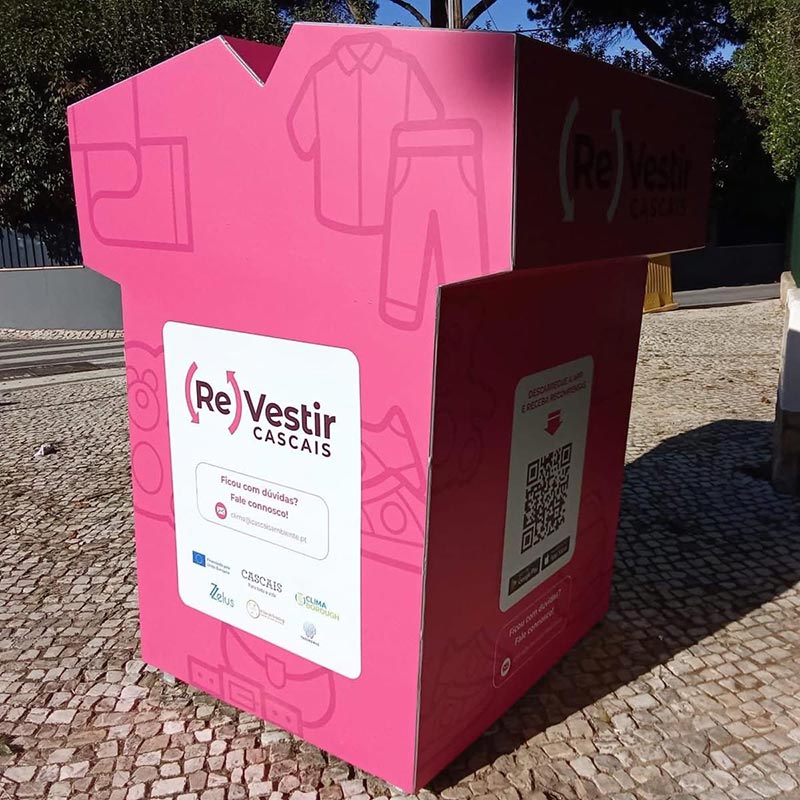
One of the pink textile collection containers used in the (Re)Vestir Cascais project
The project encouraged residents to give a second life to clothing, footwear, and household textiles through a dedicated collection system combined with digital tools. Participants received special pink collection bags with QR codes, allowing them to track the destination and environmental impact of the textiles they donated after depositing the bags in one of the project’s 15 pink containers, distributed across the municipality and clearly identified.
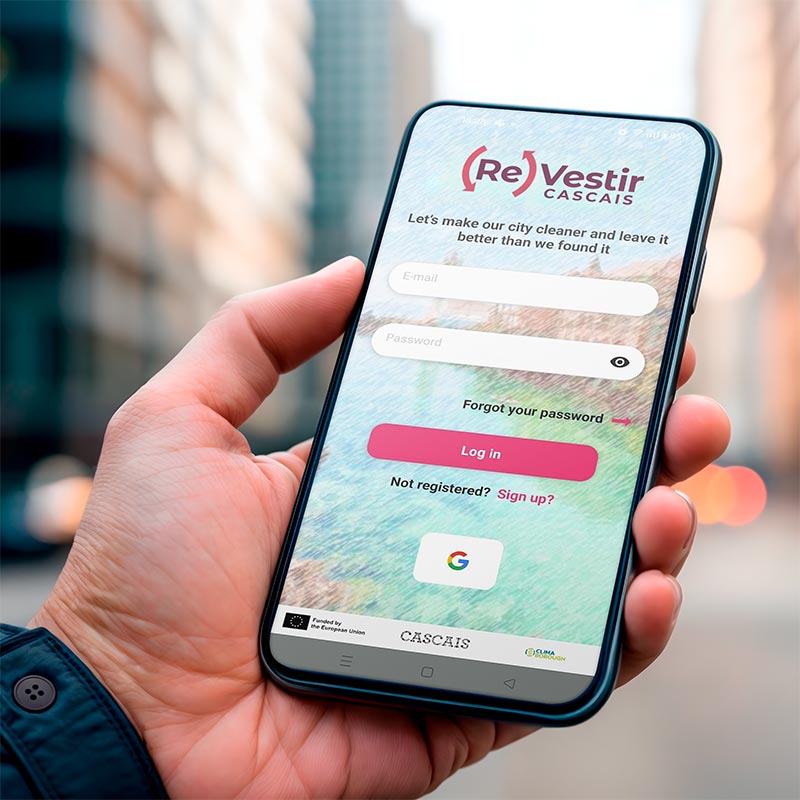
(Re)Vestir Cascais mobile app.
A mobile app supported the process by enabling users to request bags, monitor their contributions, and accumulate points that could be exchanged for rewards. The gamification component aimed to inspire behavioural change, as participants could compare their habits with friends, the wider community, or role models, motivating them to adopt more sustainable practices while rewarding their efforts.
By combining smart technology, citizen engagement, and circular economy principles, (Re)Vestir Cascais aimed at reducing the contamination of unsorted waste by textile waste, increasing transparency, and fostering change at the local level.
The initiative was supported by an awareness-raising campaign including door-to-door visits, social media posts, press releases, blog articles, and newsletters.
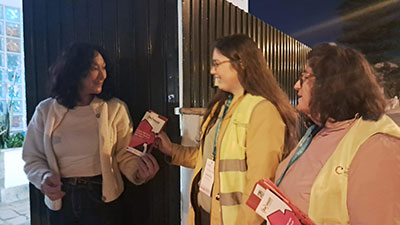
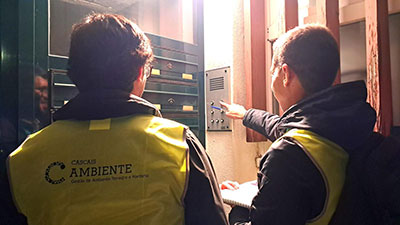
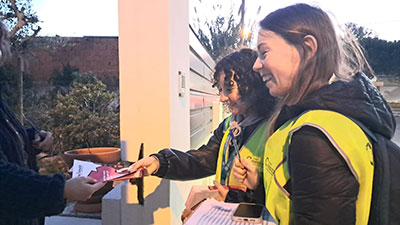
Volunteers visiting residents door to door as part of the (Re)Vestir Cascais awareness-raising campaign.
Empowering the municipality for more effective action
Understanding a problem, its causes and consequences, is the first golden rule for designing and implementing effective solutions involving the right stakeholders. Surveys can be an effective means of collecting feedback, suggestions, criticism, and needs from different actors.
The video produced by Zelus, taken from the company’s official channel, explaining how the project works
The main challenge faced by Cascais during the CLIMABOROUGH project was citizen engagement. Significant efforts were made to deploy a team of seven people in the field over the course of one month to distribute the information leaflet and the pink bags with a QR code. During this period, we reached 2,634 residents, delivered the materials to 3,199 letterboxes, and achieved nearly 300 downloads of the (Re)Vestir Cascais application.

Looking ahead, the city plans to intensify efforts to raise public awareness about textile waste and the solutions available to citizens in a broader segment of the city. This will require coordinated collaboration across municipal departments and careful management of budgetary constraints.


