

Project Description


Improperly disposed waste, not suitable for separation (AI-generated).
BLOG#16: Maribor: AI for Waste Management
City of Maribor, using AI to improve waste management and foster behavioural change
Maribor experimented a solution to improve its waste management, educating citizens on correct waste separation and collecting data on the entire end-of-life cycle in the city.
Maribor, the second largest city in Slovenia, is committed to becoming climate neutral by 2040.
The importance of a correct separation of biowaste is fundamental, as citing a study published by ScienceDirect, “Implementation of a global biowaste collection can avoid 320 million Mg of CO2 – emissions, which is almost 50 % of the overall GHG inventory of Germany”. This outlines how this is a key element towards climate neutrality.
This is why, among the various initiatives launched to achieve this goal, the City chose, within the framework of the CLIMABOROUGH project, to implement an experimental action aimed at improving biowaste separation.
The challenge
The City of Maribor is struggling with ineffective and inconsistent biowaste separation, resulting in high volumes of mixed waste. Limited public engagement and poor source separation mean recyclables often end up in the wrong containers.
This increases CO₂ emissions and delays the City’s goal of climate neutrality by 2040, while also wasting materials that could support circular and innovative local initiatives. The National Energy and Climate Plan (NECP) sets sector-specific targets for reducing greenhouse gas (GHG) emissions by 2030, compared to 2005 levels. For the waste management sector, the target is a 65% reduction.
To address this, Maribor, together with its waste collection provider, SNAGA, aims to improve mixed waste management and shift from waste disposal to true resource management. The proposed solution will strengthen waste sorting and recycling through digital technologies and artificial intelligence, supported by a robust data system that monitors and analyzes the entire waste end-of-life cycle.
How the solution works
The SCANTEC SmartScan 2.0 is an AI-driven waste management system that identifies and analyzes waste quality using convolutional neural networks trained on over 10,000 labeled images. Each training cycle requires high-performance graphics cards and takes 3–4 days.
Designed for use with various waste-collection vehicles, SmartScan captures optical-digital data, sends it to the cloud for classification, and allows results to be exported for further analysis.
The system links to the ScanSuite web portal, which compiles data on waste quality, quantity, and location into detailed visual reports, including heat maps.
How the solution was applied in the city
To do that, the municipality worked together with SNAGA, the local waste management company, and SCANTEC, the company that won the CLIMABOROUGH first call for tender.
From July 2024 to June 2025, Maribor experimented with the use of a new socio-technical system called Smart Scan, created by SCANTEC, installed in a waste-collecting truck to scan and monitor waste. The data collected was useful to better understand citizens’ behaviour and improve their engagement.
The project started with SNAGA introducing new collection routines, including a three-week garbage bin collection cycle, and translating the SCANTEC digital portal into Slovenian. The objective was to involve 250 citizens in the targeted settlements of Pobrežje and Tezno.
The video from the SCANTEC GmbH YouTube channel presents the SCANTEC SmartScan 2.0 system and shows how SNAGA can identify errors in waste separation and raise citizens’ awareness.
On one hand, the project sought to engage citizens through a door-to-door approach, followed by a media campaign and coordination meetings. On the other, SNAGA and SCANTEC worked together to train workers, adjust truck-mounted devices, and install the scanning equipment.
Citizens were required to sign a pilot application and consent to SNAGA communicating the results of waste scanning and providing recommendations whenever issues were detected, either via SMS or email.
The results of the experimentation
As in all experiments, several issues arose, including low interest from citizens and technical problems. In the end, 213 households participated, from a pool of over 1,000 that were informed.
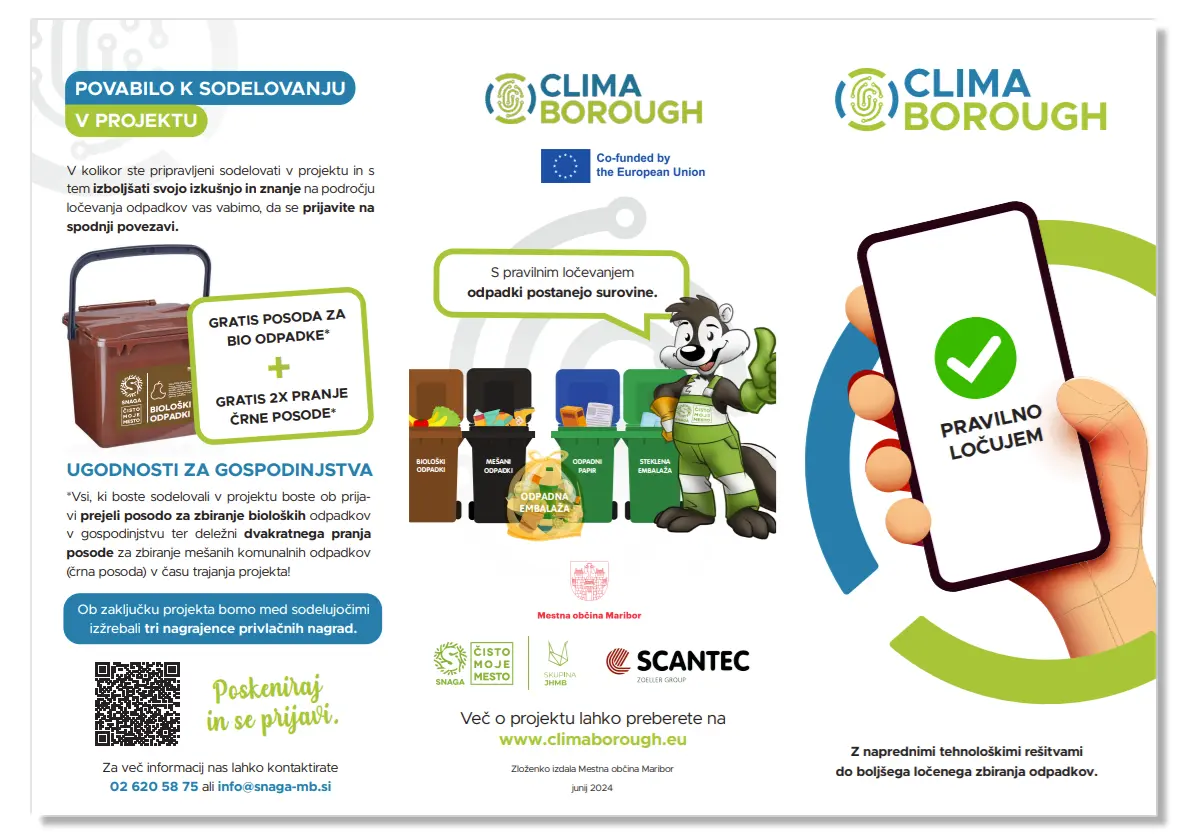
Promotional and informational flyer used to recruit citizens for a pilot project on organic waste separation, supported by digital technologies and artificial intelligence.
In particular, the sensor needed the waste not to be closed in bags, otherwise the sensor couldn’t scan it. This element showed to be a trigger to create resistance in users as they needed to change their way of keeping the waste home. Some testers dropped following some comments from the application explaining how they mistakenly treated their waste.
Moreover, some residents didn’t agree to be contacted by the municipality for updates on the process and continued putting waste in plastic bags, which made it difficult for the sensors to identify the content.
To gather more data and engage more people, the project later involved a new settlement, Razvanje. Since residents there were more motivated, the outcome was more positive, with more people interested in collaborating with the municipality compared to the other two targeted areas. Overall, 213 households accepted to test the solution.
What happens next?
The project represents an important step toward implementing advisory inspections without direct human intervention, thus saving time and allowing more effective and broader data collection coverage.
In the months following the experimentations, the first focus was to shift to integrating data systems more fully. Hardware upgrades were applied, such as installing better cameras on the truck. Additional data inputs from SNAGA will be incorporated, while SCANTEC localizes portal functions to better reflect Slovenian waste categories.
If supported by strong political will and sufficient funding, Maribor would like to scale up the solution by purchasing additional devices and expanding coverage to the entire city. SNAGA and Maribor are advocating for further dedicated funds to support research and development.
Additionally, a long-term vision includes promoting behavioural change through targeted campaigns in specific streets or settlements to engage directly with citizens.

This experience proves that digital innovation and citizen engagement are key to advancing the green transition. The public–private partnership can help test new ways to foster local, concrete change.


