

Project Description

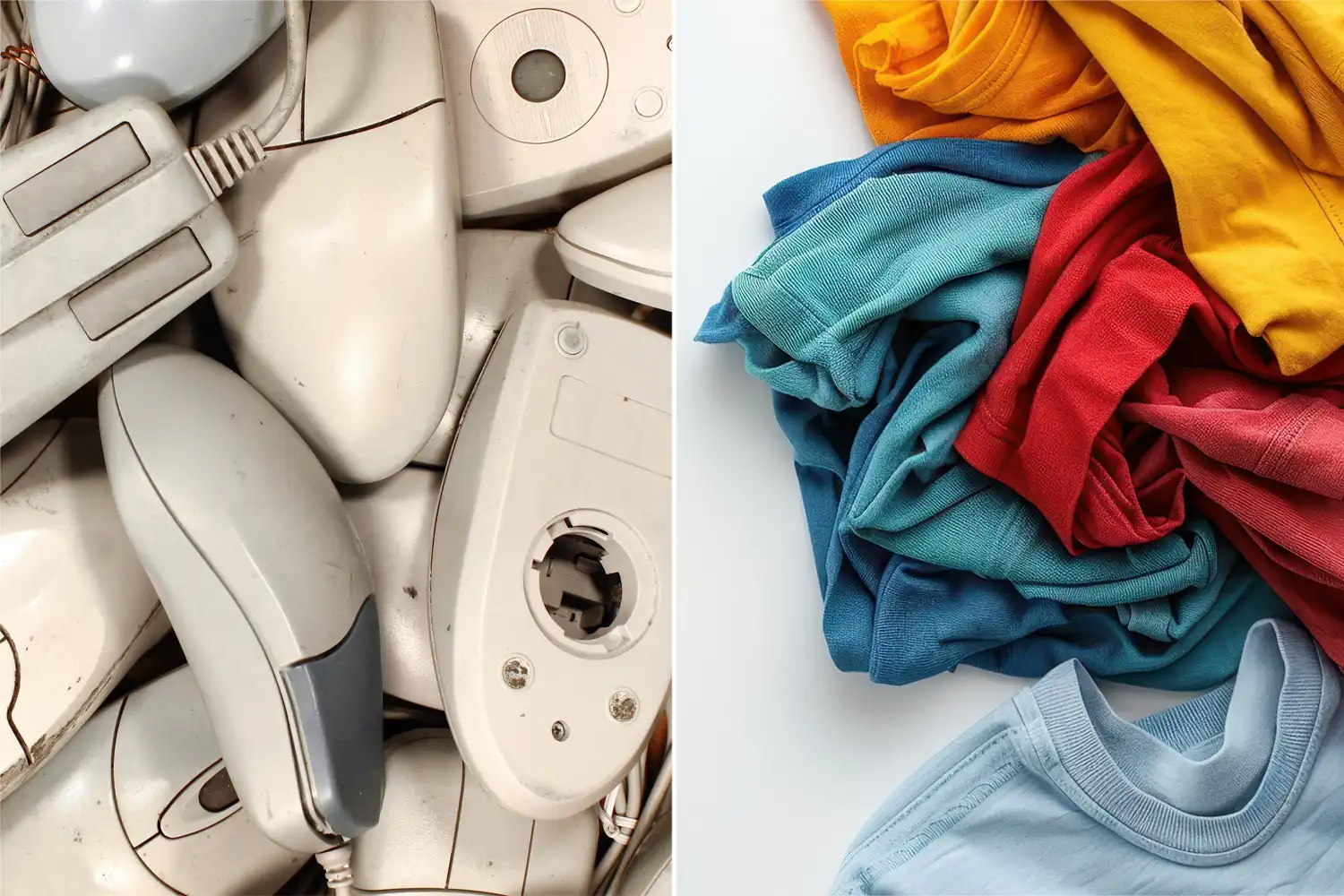
Symbolic image of electronic waste and textile waste
BLOG#14: Turin: citizens driving the circular economy
Turin: making citizens the main actors of the circular economy
The initiatives RiVestiTO and Traccia-TO aim to provide the tools and knowledge needed to improve the WEEE and textile waste management
Turin is an important business and cultural centre in northern Italy, home to over 850,000 people. As one of the 112 European Mission Cities, Turin is committed to achieving climate neutrality by 2030.
Among the diverse green transition challenges the city needs to address, one is related to the improvement of Waste Electrical and Electronic Equipment (WEEE) and textile waste management.
Within the CLIMABOROUGH project, a public procurement call awarded two entities to help Turin tackle the waste management challenge: RiVestiTO and Traccia-TO.
Go to page The Climhubs
RiVestiTo: fostering a circular economy by giving new life to discarded garments
The RiVestiTO project logo
RiVestiTo is a consortium of companies composed of Atelier Riforma, Mercato Circolare and Huulke. In one year (October 2024-2025), it will make the management of textile materials more transparent and efficient through the use of two innovative technologies – Re4Circular and Mercato Circolare App. Both initiatives aim to raise awareness and support reuse practices and the circular economy culture.
According to a survey RiVestiTo recently carried out, of the 1,200 people involved:
- 60% use second-hand clothes
- 40% throw in the undifferentiated waste worn-out clothes
- 10% throw in the undifferentiated waste clothes in good condition
- 20% throw in the undifferentiated waste household textiles.
To make the collection of discarded textiles in Turin more transparent and efficient, and direct them towards the most suitable valorisation methods, RiVestiTo created Re4Circular. Through artificial intelligence, this platform helps organisations collect used clothing, classify and digitise them, directing them to professionals and companies practicing reuse, upcycling, and textile recycling.
More about the project Re4Circular
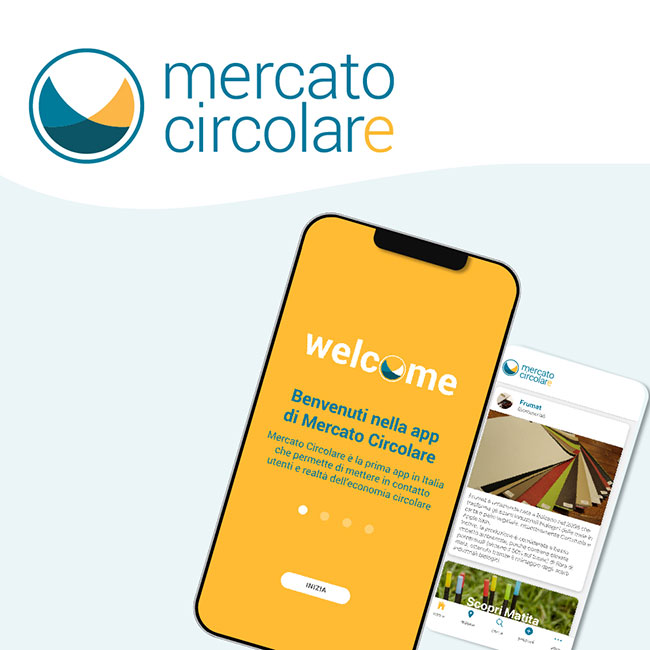
The “Mercato-Circolare” app
The other tool is the Mercato Circolare App. Its aim is to connect users with businesses and organisations operating according to circular economy principles, fostering a virtuous network where supply and demand meet. Mapping the municipal areas, they have scouted the initiatives to be included: 50 second-hand and vintage shops; 29 upcycling brands and 9 ‘circular’ artisans; 29 classic tailor shops for repairs; 16 various organizations that collect used clothes.
The “Mercato-Circolare” app
Cover for RiVestiTo Live’s ‘Dire, Fare, Giocare Circolare’ events
To raise awareness, RiVestiTo has designed the format RiVestiTo Live – dire, fare, giocare circolare, a series of six free and public events that inform about environmental and social issues caused by the textile supply chain, thus promoting reuse and circular economy practices.
Finally, the RiVestiTo team has created experimental corridors so that local professionals and companies adhering to this project and working with textile material, can freely receive, process and sell (in limited quantities and with tracking obligation) different types of material such as industrial/craft tailoring scraps, unsold pre-consumer textiles, defective pre-consumer textiles and post-consumer textiles. For instance, it is now under discussion the possibility to save about 1,000 discarded Municipal Police uniforms by giving them to local artisans and craftswomen for upcycling activities.
RiVestiTo has been presented at 10 in-person events and 2 webinars and 2 classroom presentations so far.
Traccia-TO: fostering a behavioural change in citizens
Traccia-TO is a consortium composed of Cooperativa Erica, Erion and ReLearn, aiming to develop a scalable and replicable model to increase the collection rate of waste—primarily textiles but also small WEEE (Waste Electrical and Electronic Equipment)—starting from the San Salvario district in Turin. The project is structured in three phases:
Cooperativa Erica:
https://www.cooperica.it/
Erion: https://erion.it/it/
Re-learn: https://www.re-learn.eu/
- Monitoring and mapping – 9 collection bins were monitored between October 2024 and January 2025. The result shows that about 25% of the textile materials were in good condition and potentially reusable.After the monitoring, Traccia-TO identified 50 stakeholders involved in textiles and WEEE (collection, repair, sale, or reuse). These businesses are generally sensitive to environmental topics, with some of them producing or selling sustainable goods. Many stakeholders expressed interest in collaborating with AMIAT (the waste management company of the City) and the city of Turin, particularly regarding textile waste, even offering to serve as collection points. The mapping may also help AMIAT and the Municipality optimize waste collection routes and services.
- Citizen engagement and awareness campaigns – the second phase will involve citizens more directly through awareness campaigns and call-to-action initiatives.
- Impact evaluation – the final phase will assess whether the project succeeded in informing citizens and fostering a behavioural change.
Also, Traccia-TO asked for the citizens’ point of view on the topic. Participants demonstrated interest in local waste management, but also highlighted concrete challenges:
- Perceived lack of collection points for both textiles and WEEE.
- Knowledge gaps – participants expressed a need for clearer and more accessible information regarding where and how to dispose of items, especially technological products.
- Neighborhood-Centric Solutions – many suggested involving local businesses and associations in collection, recycling, and reuse efforts.
What’s next?
Interviews prove that a successful strategy requires a strong collaboration between public institutions and local actors and a neighborhood-based approach that is inclusive, accessible, and informative.
New monitoring points will be added for both textiles and WEEE in the target area to gauge the residents’ response in May.
Simultaneously, the awareness campaign will be launched, aiming to inform about disposal practices through informational materials, call-to-action efforts in schools and the neighborhood, and upcycling events within the community.

Sign up for our newsletter to stay in the loop and receive updates on the CLIMABOROUGH project!


