

Project Description


Grenoble nestled in the Alpine valley, seen from the surrounding mountains. (Photo: © Adobe Stock)
BLOG#21: Grenoble Grand Alpes: making the city resilient to heat waves
Making the city resilient to heat waves in Grenoble Grand Alpes
Through the latest technologies, Grenoble Alpes Métropole aims to develop urban projects that counteract the consequences of climate change
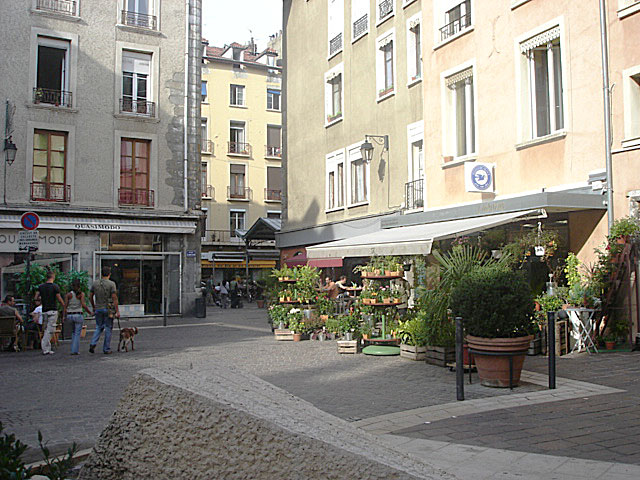
Place Claveyson, a square in the heart of Grenoble’s historic city centre. (Photo: © Wikimedia Commons)
Grenoble Alpes Métropole (GAM) is a French intercommunal authority uniting 49 communes and around 450,000 inhabitants in the Alps, known for combining economic dynamism with long-standing environmental leadership. It was the first French metropolitan area to adopt a comprehensive Air, Energy and Climate Plan (2005) and was designated European Green Capital in 2022 for its proactive environmental policies.
The Métropole drives ambitious sustainability initiatives, ranging from climate transition, ecological procurement and biodiversity measures to citizen-led climate governance through its Convention citoyenne pour le climat.
Addressing urban overheating, especially where vulnerable people live
In the context of CLIMABOROUGH, GAM wanted to address urban overheating by developing tools able to measure the impact of development projects on urban heat islands and thermal stress. The Metropole needed to develop internal expertise on the topic, and reduce the impact of development projects on urban overheating.

Urban heat island effect on a city street. AI-generated image. (Photo: © Adobe Stock)
GrandAlpe was chosen as the pilot area because of the ongoing major renewal and its significant economic, social, and environmental implications. While six metropolitan departments were engaged in the process of defining their needs, academic researchers and climatologists contributed to enhancing officers’ knowledge of urban overheating.
Technology at the service of society
Both solutions that won the public procurement call focus on data analysis and innovation to map and assess the impact of urban projects. Their main challenge is to develop robust indicators and modelling modules capable of producing clear and usable data.
Both Siradel-Hexadone and ClimaGre have developed a digital twin that models and quantifies the impact of urban projects on urban overheating. Through 17 key indicators, the solution assesses redevelopment plans by analysing Urban Heat Island (UHI) effects, thermal comfort, and carbon sequestration, directly influencing biodiversity. The analysis aims to develop a thermal stress map, which could be overlaid on vulnerability maps to guide public action. The final goal is to enhance decision-making and foster awareness among local stakeholders.
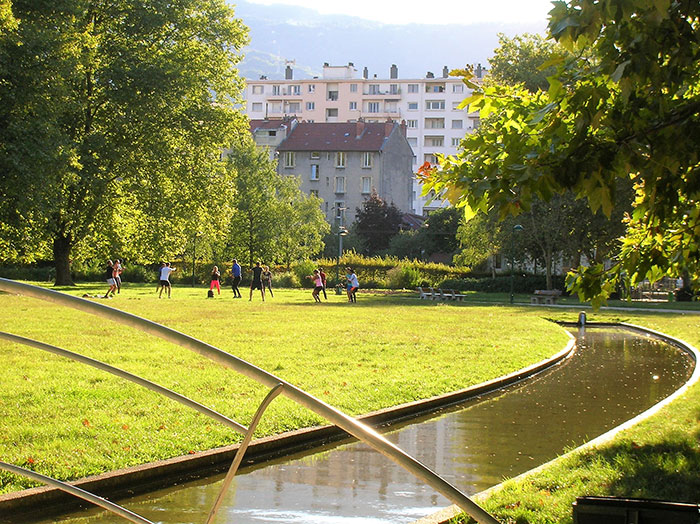
Parc Pompidou, Grenoble (Photo: © Wikimedia Commons)
Striving to make the Métropole liveable also in summertime
Thanks to CLIMABOROUGH, Grenoble Alpes Métropole has significantly deepened its understanding of urban overheating and its cross-departmental coordination challenges. This journey has led to the integration of a dedicated chapter on climate adaptation and urban heat into the Métropole’s key strategic framework for climate action — the Plan Climat.
Beyond institutional planning, the project has also strengthened the Métropole’s capacity to engage its population on climate issues, equipping local authorities with new mediation tools, including the organisation of citizen debates on urban cooling and heat resilience.


