


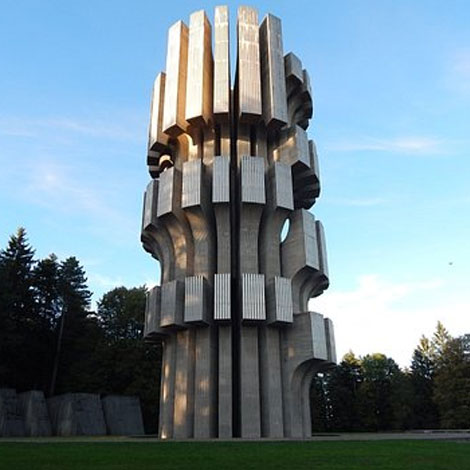
TENDER CHALLEGES /
Prijedor
Prijedor
Description of the challenge and of the envisaged solution(s)
The low level of selective collection of local waste is a challenge for many developing countries, including Bosnia and Herzegovina and the city of Prijedor. The process of constant urbanization puts multiple pressures on the waste management system in the city. Most of the local waste is generated in urban areas where the population is most numerous. The accumulation of large amounts of waste in a limited space, the impossibility of frequently emptying containers due to intense traffic, as well as the insufficient level of awareness among the population about the importance of this topic, are key problems that make the challenge even bigger. Management of solid waste in the city of Prijedor represents a major environmental problem, because the improperly disposed solid waste pollutes all components of the environment: air, soil, surface and underground water. This situation has a negative impact and poses a great danger to people’s health. Around 25,000 tons of waste of various types are collected annually in the city of Prijedor. Of this amount, less than 1% goes to recycling, i.e. around 230 tons of waste per year. Although the city company for waste management is involved in some value chains and has an established market for recyclable materials, the quantities of waste that are further exploited (recycled) are still at the level of a statistical error. This clearly indicates that there is wide room for improvement.
Solutions envisaged
Socio-technical systems based on smart combinations of software (such as IT platforms and apps) and hardware (such as mobile and desktop devices, IoT sensors, “smart” bins and waste containers, etc.) that may help the City Administration to raise the awareness of citizens and start changing their behaviours
when it comes to waste segregation, while increasing the quantities of separately collected waste.
Envisaged solutions should ideally enable the generation and monitoring of various performance indicators, e.g. quantities of properly separated waste per type (such as paper, cardboard, glass, plastic, metal and electronic waste) per location, household and individual in a specific time frame and under different incentive policies. The key stakeholders are the city utility company, PREDA and the City Hall of Prijedor, as well as local residents who should be involved in the piloting activities. It is necessary to raise public awareness and organize educational activities about waste sorting that can be reused and become a valuable raw material for a climate-neutral economy. The solutions should include elements of gamification, particularly to activate the younger population to participate in the implementation of the pilot. Additionally, these elements would ensure greater visibility and easier participation in the project.
Information on the location of the experimentation
The city of Prijedor is a local community with about 90,000 inhabitants. About 75% of the population, or about 70,000 inhabitants, is covered by the services of the public utility company. About 50% of the coverage of the local community is in rural areas where the services of public utility companies are not fully available. The project will be implemented in two or more selected urban areas of the city of Prijedor, implying the implementation of measures whose main goal is to create assumptions for increasing the amount of selectively collected waste.
General intention is to involve at least two specific urban parts of the city – one characterised by a relatively high density of residential multiple-floor buildings, and the other characterised by a relatively high density of single-family homes. This will enable better understanding of the specificities, similarities and differences of the residents’ behavioural patterns in selective waste collection.
Specific requirements include one or more of the points below
– Solutions that use official language(s) in Bosnia and Herzegovina as leading language(s);
– Solutions that include guidelines on how to use the technologies and services provided;
– Solutions that are freely accessible and operational 24/7;
– Solutions that are promptly available as applications (for smartphones and tablet PCs, on Android and/or IOS operating systems) linked to the specific
infrastructure (devices and smart items);
– Solutions that embed gamification and/or educational aspects, such as general or specific advice on how to improve waste segregation, understand data
visualisations, etc.
Minimum requirements
Data usage
“The solution should at least rely on the following datasets”: See points 2-3-4 below.
Data acquisition
“The provider should at least acquire the following datasets”: Third party data describing the pilot characteristics, preferably in a state ready for publication as open data (i.e. anonymised).
Data availability
“The provider should at least use the following datasets made available by the City”:
– Total annual quantity of collected waste and quantity and type of waste collected for recycling
– Area features and users covered by the waste collection system.
Data generation
“The solution should at least generate the following datasets”:
– Quantity and type of separately collected waste
– Number of users
– Success rate (per pilot location and in a specific time frame).
Data visualisation
“The solution should at least enable visualisation of the following datasets:” Same as point 4 above.
Socio-technical solution A
“The active engagement of citizens/users should at least be ensured during the 9 months of experimentation”
Socio-technical solution B
“The way active engagement of citizens will contribute to a better performance of the solution should be described in detail”
Socio-technical solution C
“A minimum number of 150 households or 300 citizens should be engaged by the provider during the 9 months of experimentation”
Socio-technical solution D
“The solution should at least demonstrate impacts on the following citizen/user behaviours”:
– Knowledge of the possibility of selective disposal of waste
– Awareness of the importance of selective disposal
– Increase of selectively disposed waste quantities
– Readiness to contribute to the improvement of the waste collection system.
Socio-technical solution E
“The provider should involve at least two of the following local stakeholders during the 9 months of experimentation”: Public waste management company, Educational institutions, Media, Civil society organisations, Associations of apartment owners (ZEV), any other form of local community organisation in the area of operation.
Interoperability
“The solution should at least be interoperable with the following existing IT systems”: Not applicable to this pilot.
Privacy
“Use of the solution should not imply the release of personal data unless for specific and motivated purposes”
Sandbox
“The provider should specify which rules/regulations should be temporarily lifted for the purpose of the experimentation”
Scalability
“The provider should specify how the solution can be scaled from the site of experimentation to the broad City level”
Transferability
“The provider should specify the conditions under which the same solution can be adopted by other Cities with similar challenges”
To participate to the tender, please read our tender documentation, this page is a simple overview about the challenge. To visit the documentation, click on the green button below.
Prijedor NEWS

Contributions to the Preliminary Market Consultations are extended
In June 2023, CLIMABOROUGH initiated its Preliminary Market Consultations in 8 European Cities: Athens

Preliminary Market Consultations announcements are OUT
With the European Climate Law, the EU is committing to carbon


